ClawHosters
by Daniel Samer
7 min read
Loading...
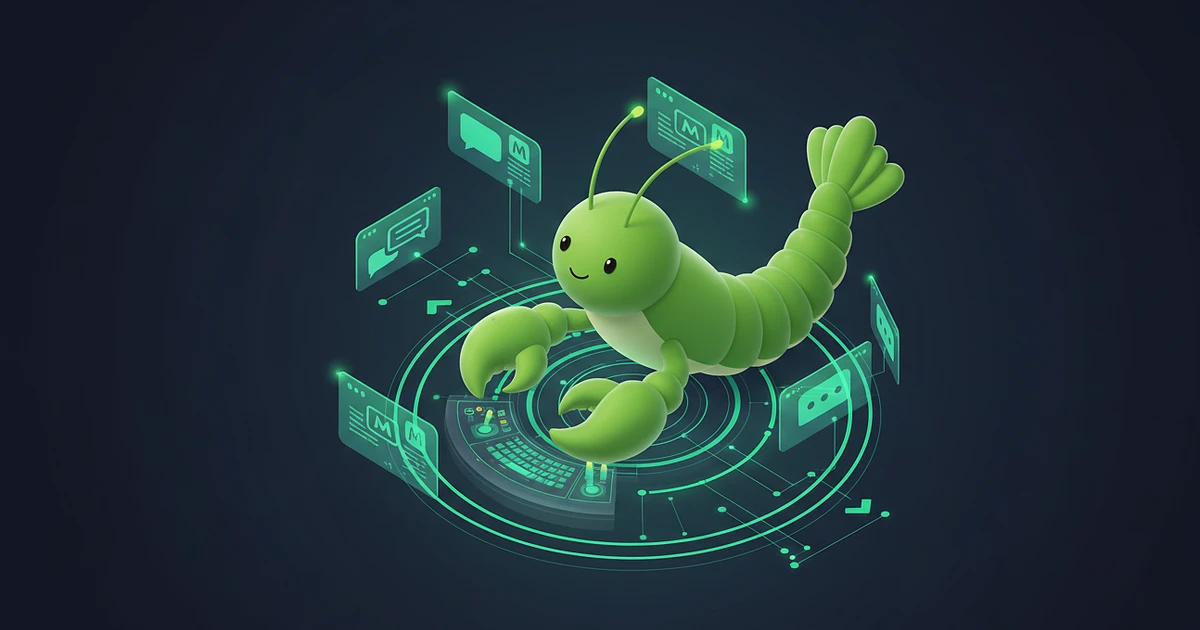
Your OpenClaw agent is smart. It reads emails, classifies intent, drafts replies, remembers context from two weeks ago. But then you ask it to update a Google Sheet and it burns 4,000 tokens on what should be a two-line API call.
That's the problem. OpenClaw is an intelligence layer. It reasons, it remembers, it handles ambiguity well. What it doesn't do well is structured, repeatable execution. Sending a Slack message, updating a CRM row, generating a PDF invoice: none of these need an LLM. They need reliable automation.
That's where n8n comes in.
n8n is a visual workflow automation tool with 400+ native integrations and over 7,800 community templates. You drag nodes onto a canvas, connect them, and they execute deterministically. No token costs. No hallucination risk on a simple HTTP POST.
The n8n AI agent architecture is clean. OpenClaw handles judgment calls (classifying emails, qualifying leads, summarizing documents). n8n handles structured execution (routing tickets, posting to Slack, logging to spreadsheets). Webhooks bridge the two. This ai workflow automation pattern keeps each tool doing what it does best.
As noted in N8N Lab's integration guide, combining OpenClaw with n8n adds observability and a security layer that OpenClaw lacks on its own.
Here's why this matters in practice:
Cost: According to LumaDock's optimization guide, 60 to 80% of typical agent tasks are deterministic enough to skip LLM inference entirely. That's real money if you're running Claude Opus 4 at $15/M input tokens.
Security: API keys live in n8n's encrypted credential store. OpenClaw never touches them directly. After the January 2026 security findings (341 malicious ClawHub skills, CVE-2026-25253), credential isolation stopped being optional for serious deployments.
Auditability: Every workflow step is visible in n8n's UI. You can see exactly what happened, when, and why. Try doing that with a chain of tool calls inside an agent loop.
The openclaw n8n integration is straightforward. OpenClaw calls n8n webhook URLs with JSON payloads. n8n processes the data and either returns a response or fires asynchronously.
Two directions are possible:
OpenClaw calls n8n (most common): Your agent classifies something, then triggers an n8n webhook to handle the execution. The thomasansems/n8n skill on ClawHub makes this easy. Install it, point it at your n8n instance, done.
n8n calls OpenClaw (advanced): The n8n-nodes-openclaw community package gives n8n access to OpenClaw's Gateway API. This lets n8n schedule agent sessions, send messages, and manage cron jobs from the visual builder. Useful if you prefer n8n as your primary control interface.
For ClawHosters users, the outbound direction (OpenClaw calling n8n) works out of the box over HTTPS. Run n8n on n8n Cloud ($24/month starter) or a small VPS alongside your ClawHosters instance. OpenClaw makes standard HTTPS calls to your n8n webhook URLs. No special configuration needed.
I think the best way to understand n8n workflow automation is through concrete examples. Here are the n8n AI agent patterns we see ClawHosters users building most often.
Email triage: Gmail trigger in n8n catches incoming mail. n8n sends the content to OpenClaw. OpenClaw classifies urgency, sentiment, and topic. Returns a JSON classification. n8n's Switch node routes it: urgent goes to Slack with a drafted reply, normal gets queued for review, spam gets archived. Your agent handles the judgment. n8n handles the routing.
Lead qualification: Someone messages your OpenClaw agent via WhatsApp or Telegram. The agent evaluates intent, asks qualifying questions, extracts structured data (budget, timeline, needs). When qualified, it fires an n8n webhook. n8n creates the CRM entry, sends a follow-up email, and notifies your sales channel. Zero manual data entry.
Content pipeline: OpenClaw drafts blog content or social posts from a brief. Fires a webhook to n8n with the draft. n8n formats it, pushes to WordPress or Buffer, logs the publish to a tracking sheet, and schedules a reminder to check engagement in 48 hours. The creative work stays with the LLM. The publishing plumbing stays with n8n.
Invoice generation: You message your agent: "Invoice Client X for January, 40 hours at $150/hr." OpenClaw calculates totals, pulls client billing details from memory, and triggers n8n. n8n generates the PDF, emails it, logs to QuickBooks, sets a 30-day payment reminder. As the Future Humanism guide puts it: the agent decides, n8n executes.
Not everything needs to go through n8n. And not everything needs LLM reasoning.
Keep in OpenClaw: Ambiguous inputs. Tasks requiring context from previous conversations. Anything that needs natural language understanding, summarization, or judgment calls. If a human would need to think about it, let the agent think about it.
Route to n8n: Predictable, structured tasks. If you could write an if/else statement for it, it probably belongs in n8n. Moving data between apps, formatting, scheduling, notifications, file operations.
The honest answer is that you'll figure out the split through trial and error. Start with your n8n AI agent handling everything in OpenClaw, then look at your token usage logs. The tasks eating tokens without needing real reasoning? Move those to n8n workflows.
If you're on ClawHosters, your OpenClaw instance is already running 24/7 with automatic security patches on Hetzner Germany infrastructure. Pair it with n8n Cloud or a self-hosted n8n instance and you have a production-ready ai workflow automation stack.
Plans start at $19/month. You can deploy your first agent and connect it to n8n in probably 20 minutes. The caprihan/openclaw-n8n-stack project on GitHub is a good reference for the architecture even if you're using ClawHosters rather than self-hosting.
You can also cut token costs by 77% before you even add n8n to the mix.
An n8n AI agent workflow combines an AI agent (like OpenClaw) with n8n's visual automation platform. The AI agent handles reasoning and natural language tasks. n8n handles structured execution across 400+ apps. They connect through webhooks, so the agent makes decisions and n8n carries them out. No coding required on the n8n side.
Yes. Your ClawHosters-hosted OpenClaw instance makes outbound HTTPS calls to n8n webhook URLs. Run n8n wherever you prefer: n8n Cloud, a separate VPS, or your local machine during development. The connection works over standard HTTPS with no special configuration.
ClawHosters plans start at $19/month for managed OpenClaw hosting. n8n's self-hosted Community Edition is free. n8n Cloud starts at $24/month. A common setup is ClawHosters + a $5 to $10/month VPS running n8n, totaling roughly $25 to $30/month for a full AI automation stack.
No. They solve different problems. OpenClaw handles ambiguous reasoning, persistent memory, and natural language understanding. n8n handles deterministic workflow execution across hundreds of apps. You probably need both if you're building anything beyond a simple chatbot.
Install the n8n skill from ClawHub (thomasansems/n8n). Configure it with your n8n instance URL. Create a webhook trigger node in n8n. When OpenClaw needs to trigger a workflow, it calls the webhook URL with a JSON payload. n8n processes the request and executes the workflow. The whole setup takes about 15 minutes.
*Last updated: March 2026*
Three open-source AI agent frameworks launched within two weeks of each other in early 2026. All three have the word "Claw" in the name. All three let you run your own AI assistant. And all three make completely different bets about what matters most.

Your OpenClaw agent reads, writes, searches the web, calls tools. But it can't hear you. And it can't talk back. Voice changes that, and it's not as complicated as you'd think.

Port forwarding your AI agent to the public internet is a terrible idea. OpenClaw has broad access to your system, shell, files, network, and it eagerly reaches out to external APIs. Exposing that to the open web is asking for trouble. Tailscale gives you encrypted remote access to your OpenClaw...