ClawHosters
by Daniel Samer
7 min read
Loading...
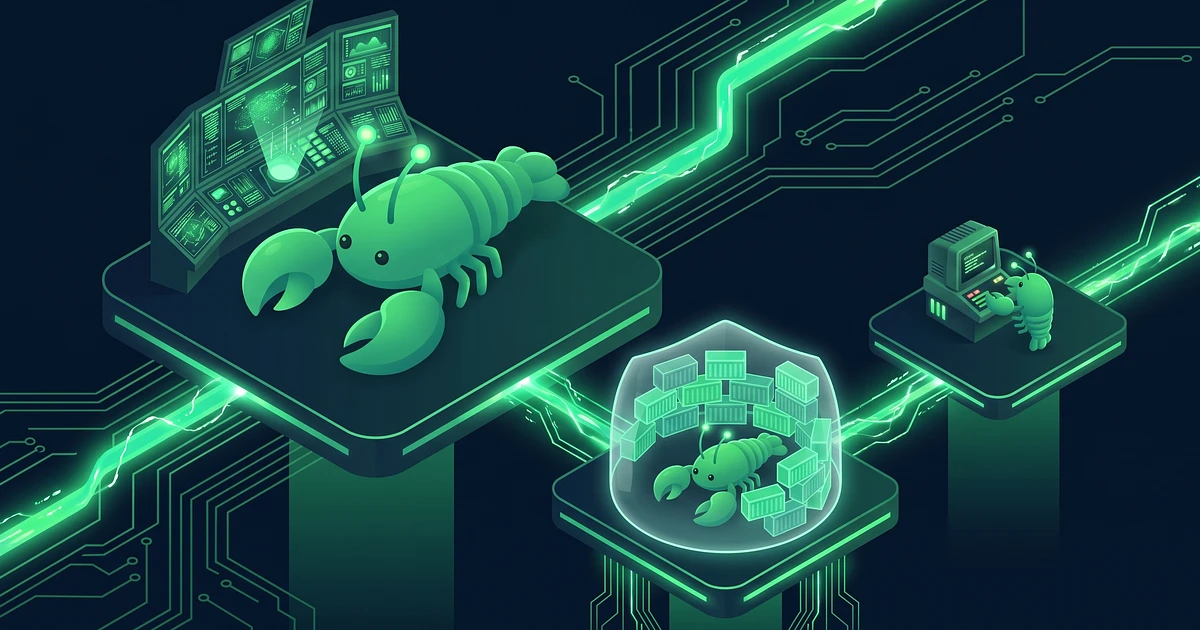
Three open-source AI agent frameworks launched within two weeks of each other in early 2026. All three have the word "Claw" in the name. All three let you run your own AI assistant. And all three make completely different bets about what matters most.
OpenClaw bets on features. NanoClaw bets on security. ZeroClaw bets on being small and fast.
Picking the wrong one wastes your time. Here's how to pick the right one.
OpenClaw has 379,000 GitHub stars, making it the most-starred project in GitHub history. The ecosystem is enormous: 430,000+ lines of TypeScript, 50+ messaging channel integrations, and over 12,000 skills on the ClawHub marketplace. If you want voice mode, cron jobs, multi-agent workflows, or a WhatsApp bot that also reads your email, OpenClaw probably has a skill for that.
But that size comes with real costs.
According to security researchers tracking OpenClaw's CVE history, the project accumulated 138+ CVEs in under five months of 2026. Microsoft stated it's "not appropriate to run on a standard personal or corporate machine." And then there's the ClawHavoc incident, where 1,184 malicious skills flooded ClawHub, representing roughly 12% of uploads at peak. Those skills stole browser credentials, SSH keys, and crypto wallets.
Resource-wise, OpenClaw needs 1GB+ of RAM and takes 2 to 6 seconds for a cold start. Self-hosting means 4+ hours of Docker, VPS, and firewall configuration. Most people who try give up partway through. (That's why we built ClawHosters, which handles the entire deployment in under a minute, but more on that later.)
Best for: People who need the biggest feature set and largest community, and are willing to accept the security and resource overhead that comes with it.
NanoClaw exists because its creators looked at OpenClaw's codebase and asked a simple question: "If you cannot verify what an agent is doing, should you trust it with your data?"
Their answer was about 700 lines of TypeScript. That's the entire codebase. You can read the whole thing during a lunch break.
NanoCo raised $12M in seed funding from Docker, Vercel, and Hugging Face CEO Clem Delangue. In March 2026, Docker officially partnered with NanoClaw to run each agent inside a disposable MicroVM sandbox. If something goes wrong, the blast radius stops at the container boundary. Your host machine stays untouched.
The trade-off? NanoClaw currently supports only Claude/Anthropic models. If you need GPT-4, Gemini, or local inference, you're out of luck. The skill ecosystem is also much smaller. No marketplace with 12,000 options. You get what the 700 lines provide, plus what you build yourself.
Best for: Security-conscious teams, regulated industries (finance, legal, healthcare), and anyone who wants to audit every line of code their AI agent runs.
ZeroClaw took a different path entirely. Written in Rust by a group of Harvard and MIT students alongside the Sundai.Club community, it ships as a single 3.4MB binary. Cold boot takes under 10 milliseconds. Idle RAM usage sits below 5MB.
To put that in perspective: OpenClaw needs 1GB+ of RAM. ZeroClaw uses less than 5MB. You can run it on a Raspberry Pi Zero ($15) or even an ESP32. Factory floors deploy ZeroClaw on vibration sensors for predictive maintenance, running local LLM inference through Ollama with zero cloud dependency.
ZeroClaw supports 22+ LLM providers, including local models. That's probably its biggest practical advantage over NanoClaw. You're not locked to any vendor. The latest release, v0.8.0 (June 12, 2026), shows active development with 31,900 GitHub stars.
The downside: ZeroClaw's plugin ecosystem is young. No equivalent to ClawHub's 12,000 skills. Community support is smaller. Documentation is thinner. You'll need to be comfortable figuring some things out yourself.
Best for: Edge computing, IoT deployments, privacy-first setups with local models, and anyone who cares about running AI agents on minimal hardware.
| OpenClaw | NanoClaw | ZeroClaw | |
|---|---|---|---|
| Codebase | 430,000+ lines TS | ~700 lines TS | 3.4MB Rust binary |
| RAM (idle) | 1GB+ | ~100MB (Docker) | <5MB |
| Cold start | 2-6 seconds | ~1 second | <10ms |
| LLM providers | Multiple | Claude only | 22+ (incl. local) |
| Integrations | 50+ channels | Growing | Plugin system |
| Skill marketplace | 12,000+ (ClawHub) | Manual skills | Own registry |
| Security model | Auth + hardening | Container isolation | Allowlists |
| CVEs (2026) | 138+ | 0 known | 0 known |
| Min. hardware | 4GB RAM VPS | Docker host | Raspberry Pi Zero |
| GitHub stars | 379,000 | ~29,000 | 31,900 |
Skip the feature checklists. Think about what you actually need.
You want maximum features and the biggest community? OpenClaw. Accept the security trade-offs, harden your instance, and consider managed hosting to skip the deployment headache. Our security hardening guide covers how to lock things down properly.
You handle sensitive data and need to trust your agent? NanoClaw. The Docker sandbox model is genuinely good. Just know you're locked to Claude models for now.
You want to run AI agents on a $15 computer, or you need local-only inference? ZeroClaw. Nothing else in this ecosystem comes close on resource efficiency.
You're not sure yet? Start with what fits your hardware and security requirements. Features can be added. A compromised agent with access to your credentials can't be un-compromised.
If you go with OpenClaw and don't want to spend a weekend fighting Docker, ClawHosters gets you a managed instance on EU servers in under a minute. Free trial available.
NanoClaw, by a wide margin. Its ~700-line codebase is small enough to audit in full, and the Docker MicroVM sandbox isolates each agent at the OS level. ZeroClaw's allowlist model is solid too. OpenClaw's 138+ CVEs in 2026 and the ClawHavoc supply chain attack make it the riskiest choice without proper hardening.
Sort of. Your agent's persona and configuration won't transfer directly since each framework uses different config formats. But your LLM API keys, messaging platform tokens, and the general setup logic carry over. ZeroClaw even has a community migration guide for OpenClaw users.
Yes. All three frameworks are BYOK (Bring Your Own Key). You pay your LLM provider (Anthropic, OpenAI, etc.) separately. ZeroClaw is the only one that supports fully local models through Ollama, meaning you can skip API costs entirely if you have the hardware for local inference.
It can be, with effort. Enable authentication, keep it updated, and avoid installing unverified ClawHub skills. The self-hosted vs managed comparison on our blog breaks down what you need to lock down. Or use managed hosting where security patches are applied automatically.
The Claw ecosystem includes at least a dozen projects: PicoClaw (Go, ultra-small), IronClaw (Rust, TEE-backed security), MicroClaw, Moltis, and others. OpenClaw, NanoClaw, and ZeroClaw are the three with the most traction and community support as of mid-2026. The others are worth watching but haven't hit the same adoption level yet.
Your OpenClaw agent reads, writes, searches the web, calls tools. But it can't hear you. And it can't talk back. Voice changes that, and it's not as complicated as you'd think.

Port forwarding your AI agent to the public internet is a terrible idea. OpenClaw has broad access to your system, shell, files, network, and it eagerly reaches out to external APIs. Exposing that to the open web is asking for trouble. Tailscale gives you encrypted remote access to your OpenClaw...
Your AI agent knows a lot about the world. But it knows nothing about your project board, your meeting notes, or that CRM database you built in Notion last Tuesday. The Notion MCP server fixes that.