ClawHosters
by Daniel Samer
6 min read
Loading...
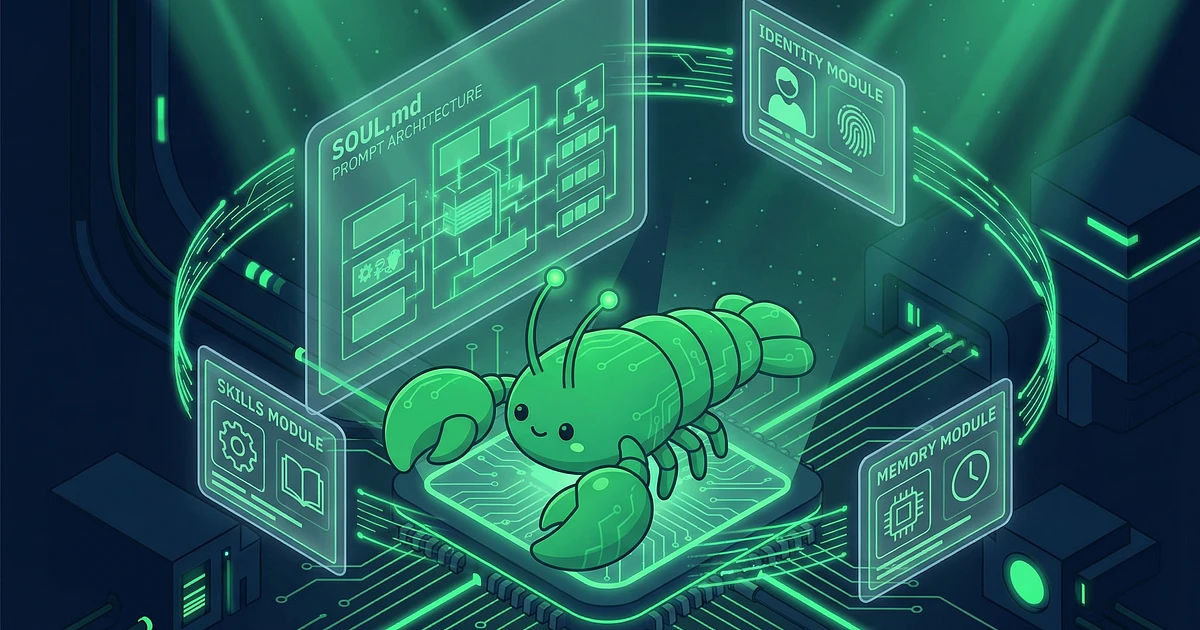
Most people treat OpenClaw like a chat assistant. Type a question, get an answer. But that's like using a Formula 1 car to drive to the grocery store. OpenClaw is a modular prompt assembly runtime, and SOUL.md is the file that tells it who to be.
Every single message your agent processes, SOUL.md gets injected into the system prompt. Every turn. That means it costs tokens on every interaction, and it shapes every response. Get it right, and your agent feels like a colleague who knows your business. Get it wrong, and you're burning money on a confused bot.
SOUL.md is a Markdown file that defines your agent's personality, rules, and long-term instructions. Think of it as the system prompt that persists across sessions. When OpenClaw boots, it reads SOUL.md and injects its contents at the top of every conversation.
Here's what most people miss: OpenClaw doesn't just send SOUL.md to the model. It dynamically assembles a system prompt from multiple sources. Your SOUL.md, plus active Skills, plus Memory context, plus User Identity metadata, plus Model Aliases configuration. All of it gets stitched together before hitting the LLM.
That's why sub-agents behave differently from your main agent. Sub-agents get a "minimal" mode that strips memory, messaging hooks, and heartbeat functions. Same SOUL.md, different runtime context.
I've seen SOUL.md files ranging from 5 lines to 500. Both extremes cause problems. Based on what we've observed across ClawHosters instances, the sweet spot is 50 to 150 lines, organized into three sections.
Personality and Tone: How the agent communicates. "Respond in a professional but friendly tone." "Never use emojis." "Keep answers under 200 words unless asked for detail." Be specific here. "Be concise" means nothing to an LLM. "Maximum 5 bullet points per response" gives it something to work with.
Core Rules and Boundaries: What the agent must or must not do. "Never share pricing information without checking the current price list." "Always ask for order number before looking up shipment status." These are your guardrails.
Long-term Instructions: Scheduling preferences, formatting rules, workflow patterns. "When I ask about inventory, always check both warehouses." "Format all dates as DD.MM.YYYY."
One thing that trips people up, as the OpenClaw Experts guide points out: position matters. Models weight instructions at the beginning of the system prompt more heavily than instructions at the end. Your most important rules go at the top of SOUL.md. Not the middle. Not scattered around. Top.
Every character in SOUL.md costs tokens on every message. Let's do the math.
A 150-line SOUL.md file runs roughly 3,000 to 4,000 tokens. According to the DeepWiki source analysis, OpenClaw's bootstrap files (system prompt, active skills, memory context) can eat 35,600+ tokens per message before your user even types "hello." There's a per-file limit of 20,000 characters and a total limit of 150,000 characters across all loaded context.
Anthropic's prompt caching helps here. If your SOUL.md stays stable between messages (which it should), the cached portion saves 80 to 90% on input token costs. But if you're dynamically modifying SOUL.md between turns, you blow the cache every time. Our token cost optimization guide covers the full cost breakdown.
Bottom line: keep SOUL.md stable and concise. Don't stuff it with instructions you only need occasionally. Put those in Skills instead.
OpenClaw's memory system uses SQLite with FTS5 full-text search and sqlite-vec for vector embeddings. When the agent needs to recall something, it runs hybrid scoring, 70% vector similarity plus 30% BM25 keyword match, to find the most relevant memories.
Here's the key rule: if it's not written to a file, it doesn't exist long-term. Instructions you give only in chat will eventually get compacted away. We covered exactly this failure mode in our security piece about ClawBands. If a rule matters, put it in SOUL.md or a dedicated instruction file. Chat-only instructions die at compaction.
SOUL.md guardrails are advisory, not enforced. If you write "never execute shell commands" in SOUL.md, the LLM will try to respect that. But a sufficiently creative prompt injection can bypass it. SOUL.md is a suggestion layer, not a security boundary.
For hard enforcement, use tool policies in your OpenClaw configuration. Tool policies operate at the runtime level, blocking tools before the LLM even sees them. That's a wall, not a suggestion. Our security hardening guide walks through both layers.
On ClawHosters, every instance gets its own dedicated context window and pre-configured prompt settings. The dashboard gives you a UI for editing SOUL.md without touching config files, and the container isolation means your prompt context stays private.
If you're self-hosting, you manage all of this manually. The free LLM API guide covers getting started on the cheap, and our self-hosted vs managed comparison breaks down what you're signing up for.
SOUL.md is a Markdown file that defines your OpenClaw agent's personality, rules, and long-term instructions. It gets injected into the system prompt on every message, shaping how your agent responds to users.
Aim for 50 to 150 lines. Shorter files don't give the model enough guidance. Longer files eat tokens on every message and can dilute your most important instructions. Put your critical rules at the top.
No. SOUL.md instructions are advisory. The LLM will try to follow them, but prompt injection can bypass text-level rules. For hard enforcement, use OpenClaw's tool policies, which block actions at the runtime level before the model can execute them.
Sub-agents run in "minimal" mode, which strips memory, messaging hooks, and heartbeat functions from the system prompt. Your SOUL.md content still loads, but the surrounding context is different, which can change how the model interprets your instructions.
Keep SOUL.md stable between messages so prompt caching works (saves 80-90% on input tokens). Move rarely-used instructions into Skills that load on demand. Avoid dynamic modifications that blow the cache on every turn.
*Last updated: March 2026*
Three open-source AI agent frameworks launched within two weeks of each other in early 2026. All three have the word "Claw" in the name. All three let you run your own AI assistant. And all three make completely different bets about what matters most.
Your OpenClaw agent reads, writes, searches the web, calls tools. But it can't hear you. And it can't talk back. Voice changes that, and it's not as complicated as you'd think.
Port forwarding your AI agent to the public internet is a terrible idea. OpenClaw has broad access to your system, shell, files, network, and it eagerly reaches out to external APIs. Exposing that to the open web is asking for trouble. Tailscale gives you encrypted remote access to your OpenClaw...