ClawHosters
by Daniel Samer
3 min read
Loading...
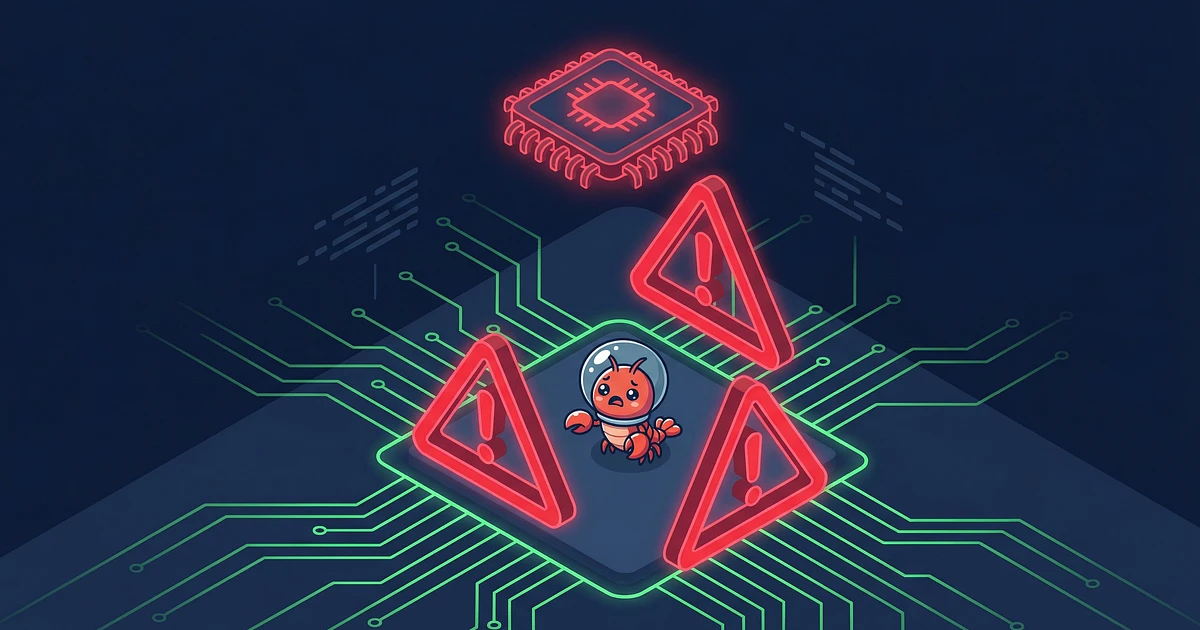
Simon Willison's lethal trifecta described three conditions that make an AI agent dangerous: access to private data, exposure to untrusted content, and the ability to communicate externally. Get all three in one system and you have a security problem. OpenClaw has all three by design.
Now Palo Alto Networks argues there's a fourth element that makes it worse.
Their February 2026 paper identifies persistent memory as an accelerant. Their exact words: "Persistent memory acts as an accelerant, amplifying the risks highlighted by the lethal trifecta."
The problem is SOUL.md and MEMORY.md. Both files get loaded at boot and treated as trusted configuration. But here's the catch: agent tools can modify them at runtime. As Penligent's research puts it, "If an attacker can trick the agent into writing a malicious instruction into its own SOUL.md, that instruction becomes part of the agent's permanent operating system."
That opens up attack classes that didn't exist before. Time-shifted prompt injection, where a payload gets injected on one day and detonates when agent state aligns later. Memory poisoning. Logic bomb-style activation across sessions.
Palo Alto mapped OpenClaw to every single category in the OWASP Top 10 for Agentic Applications. Every one.
Obsidian Security found that a single compromised agent poisoned 87% of downstream decision-making within four hours. That's not a theoretical exercise.
And Palo Alto didn't hold back on their conclusion: "The authors' opinion is that OpenClaw is not designed to be used in an enterprise ecosystem."
If you're running OpenClaw in production, you probably already know the security hardening basics. But persistent memory attacks go beyond what config hardening can catch. You need runtime monitoring, memory file integrity checks, and ideally container isolation so a compromised agent can't spread.
The OpenClaw safety scanner added memory integrity baselines in its latest update. Worth running if you haven't recently.
A term coined by Simon Willison describing three conditions that make AI agents dangerous: access to private data, exposure to untrusted content, and the ability to take external actions. OpenClaw meets all three by default.
Attack payloads can be fragmented across time. An attacker injects something into MEMORY.md on day one, and the payload activates days later when conditions align. Traditional prompt injection defenses don't catch time-delayed attacks.
Container isolation prevents a compromised agent from affecting other instances. ClawHosters provides this by default, along with automated backups of cognitive files and runtime monitoring that flags unexpected SOUL.md changes.
*Last updated: February 2026*

On May 10, Hermes Agent by Nous Research passed OpenClaw in daily token usage on OpenRouter. Hermes hit 224 billion daily tokens against OpenClaw's 186 billion. By May 21 the gap had widened: 458 billion vs 173 billion.
A UK CEO's live OpenClaw instance showed up on BreachForums in February. Price tag: $25,000 in Monero. The listing advertised full access to the CEO's AI conversations, production database, Telegram bot tokens, and Trading 212 API keys. All stored in plaintext Markdown files.
On April 22, 2026, OpenAI announced Workspace Agents for ChatGPT Business and Enterprise customers. Think always-on, cloud-hosted AI agents that plug into Slack, Salesforce, Google Drive, and about a dozen other enterprise tools.