ClawHosters
by Daniel Samer
4 min read
Loading...
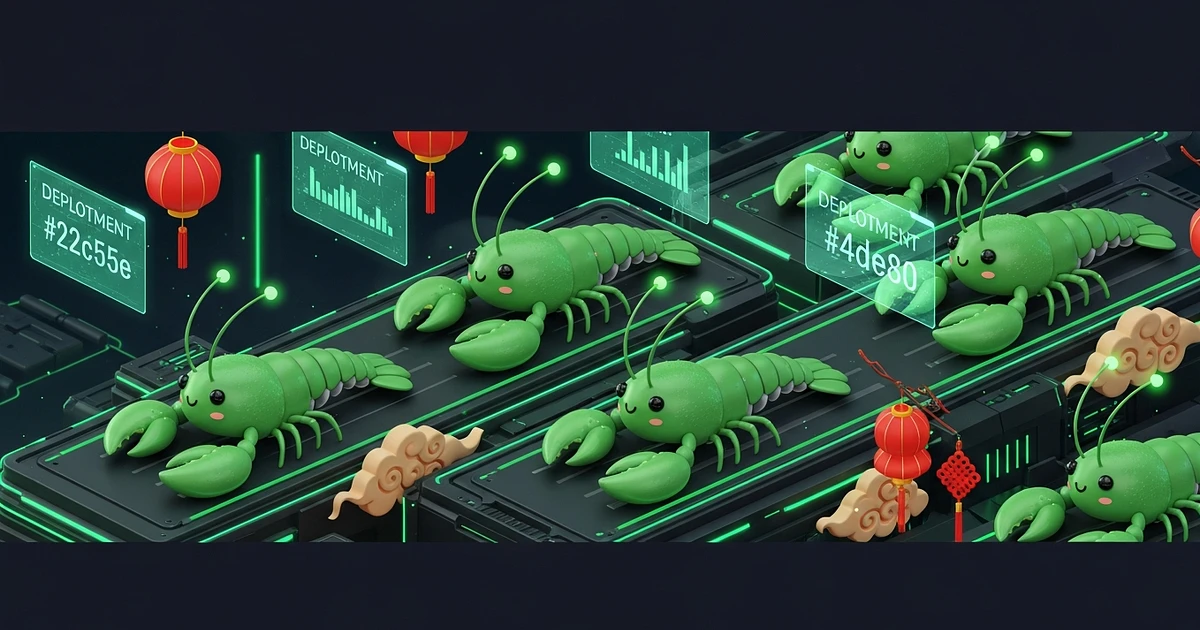
Nearly 1,000 people lined up outside Tencent's Shenzhen headquarters on March 7. Not for a product launch. Not for a concert. They queued for a free installation of an open-source AI agent built by an Austrian developer. The crowd included retired engineers, students, housewives, and amateur coders.
That's "lobster fever," and it probably tells us more about where AI agents are heading than any analyst report could.
According to SCMP, all five major Chinese cloud providers launched competing OpenClaw products within days of each other. Here's the breakdown.
Tencent branded its suite "Lobster Special Forces." QClaw integrates with WeChat and QQ, setup in three minutes. WorkBuddy deploys via WeCom in under a minute.
ByteDance went cloud-native with ArkClaw on Volcano Engine. No local setup at all. You open a browser, log in, and you're running an agent with deep Lark integration.
Alibaba Cloud took the price war route. One-click deployment for 9.9 yuan ($1.40), free DingTalk API calls through March 31.
JD.com Cloud partnered with Lenovo for remote deployment and offered a 399-yuan setup service. Baidu AI Cloud built a visual four-step deployment via its Qianfan platform.
As CNBC reported, the underlying logic is straightforward. OpenClaw agents consume 10 to 100 times more tokens per day than a typical chatbot user. Free deployments now mean locked-in inference revenue later. That's the real race.
Xiaomi went a different direction entirely. Its miclaw runs on Xiaomi 17 smartphones and connects to the Mi Home ecosystem. Say "Away" and it locks your door, starts the robot vacuum, and activates the pet feeder. In sequence. Autonomously.
The agent model is no longer just about productivity apps on a laptop.
And then there's the paradox nobody in Beijing seems bothered by. Bloomberg reported that state enterprises and banks are banned from installing OpenClaw. Security agencies flagged weak default configurations and risky third-party skill packs.
But at the same time, Shenzhen's Longgang district is offering up to 2 million yuan for open-source contributions and up to 10 million yuan in equity for seed-stage one-person companies. Wuxi put 1 to 5 million yuan on the table for industrial applications. China's NPC work report promoted AI agents for the first time this year.
Ban it in government. Fund it everywhere else. That's the strategy, apparently.
Security researchers in China are already telling users to run OpenClaw on dedicated, isolated machines. The Mac Mini sold out across the country because people listened. If you want that same isolation without sourcing hardware at a markup, managed OpenClaw hosting on EU infrastructure with GDPR compliance and proper security hardening is the alternative worth considering.
The nickname comes from OpenClaw's lobster mascot. Chinese users started calling deployment "raising a lobster," and the phrase went viral on social media platforms like Douyin and Xiaohongshu. Companies leaned into it. Tencent named its product suite "Lobster Special Forces."
No. Each provider built a distinct product. Tencent focused on WeChat and WeCom integration, ByteDance went fully browser-based with no local install, Alibaba competed on price at $1.40 per deployment, and Xiaomi moved into mobile and smart home control. The underlying OpenClaw is the same, but the wrappers are very different.
Not exactly. State enterprises, banks, and government agencies are restricted from installing it on work devices. But private companies and individuals face no restrictions. Local governments are actively subsidizing OpenClaw development with millions of yuan in incentives.
*Last updated: March 2026*

On May 10, Hermes Agent by Nous Research passed OpenClaw in daily token usage on OpenRouter. Hermes hit 224 billion daily tokens against OpenClaw's 186 billion. By May 21 the gap had widened: 458 billion vs 173 billion.
A UK CEO's live OpenClaw instance showed up on BreachForums in February. Price tag: $25,000 in Monero. The listing advertised full access to the CEO's AI conversations, production database, Telegram bot tokens, and Trading 212 API keys. All stored in plaintext Markdown files.
On April 22, 2026, OpenAI announced Workspace Agents for ChatGPT Business and Enterprise customers. Think always-on, cloud-hosted AI agents that plug into Slack, Salesforce, Google Drive, and about a dozen other enterprise tools.