ClawHosters
by Daniel Samer
4 min read
Loading...
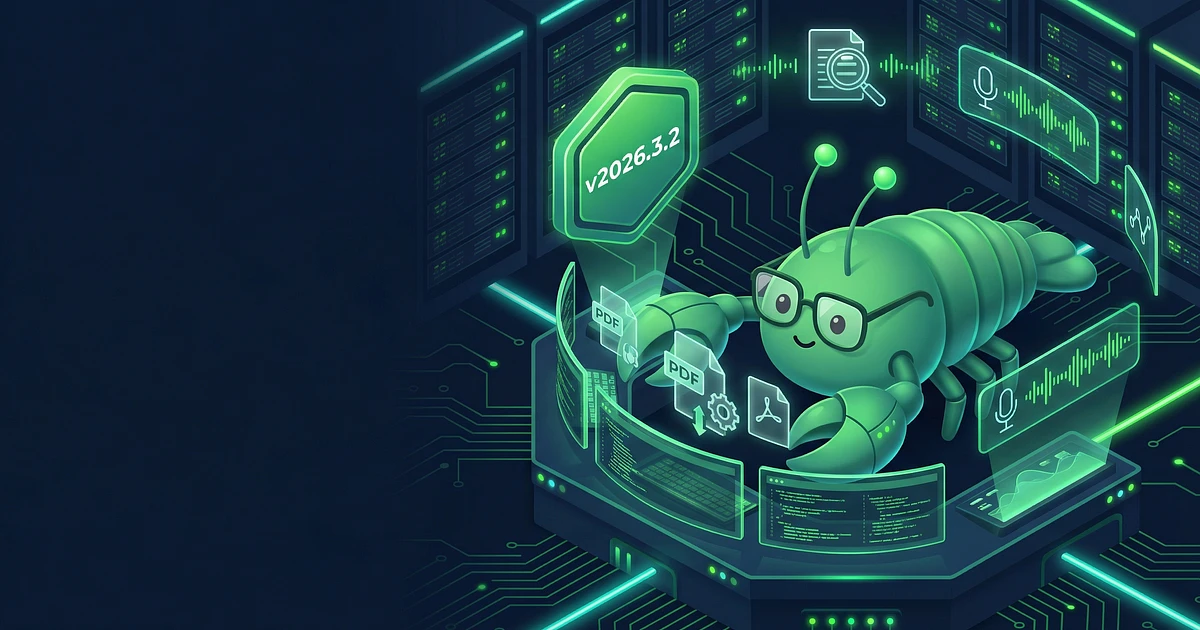
OpenClaw v2026.3.2 dropped on March 3, 2026. 93 contributors. 150+ bug fixes. Two headline features that change what your agents can do out of the box. And four breaking changes you probably want to read before hitting upgrade.
Here's what matters.
Native PDF Analysis Tool. This is the big one. OpenClaw now ships a first-class, built-in PDF tool. Not a plugin, not a community add-on. It supports both Anthropic and Google as extraction backends, with configurable page limits, file size caps, and fallback policies if extraction fails. Your agents can read, summarize, and pull structured data from PDFs without any extra setup. Think invoice processing, contract review, research digests. If your workflow touches documents, this is probably the feature you've been waiting for.
Speech-to-Text API. Plugins can now call a runtime STT method to transcribe audio files through your configured provider. Until now, OpenClaw had TTS (text-to-speech) but no way back. That gap is closed. Voice-driven workflows just got a lot more realistic.
SecretRef Expansion. The credential reference system now covers 64 targets. If you're running multi-agent setups with shared secrets across tools and integrations, you'll spend less time manually wiring credentials. Honestly, this one sounds boring but saves real headaches at scale.
Other additions include the MiniMax-M2.5-highspeed model in the provider directory, HTTP health check endpoints (/health, /healthz, /ready, /readyz) for container orchestration, and a new Listen-Only Channel Mode (suppressOutbound) for monitoring bots.
Four changes that require your attention:
registerHttpHandler is now registerHttpRoute, and explicit authentication is required. Plugin developers need to update this.None of these require data migrations. They're all configuration-level. Manageable, but don't skip them.
The release includes 40+ security hardening changes. The two that stand out: Gateway Loopback WebSocket protection (patches an attack vector known as "ClawJacked") and skill workspace symbolic link escape prevention. If you're running a ClawHosters managed instance, these patches apply automatically. Self-hosters need to update and restart manually. Our security hardening guide covers what to review.
Check your tools.profile configuration. If you never set it explicitly, your new instances will now get the "messaging" profile instead of the old broad default. Everything else rolls out through managed updates. If you're not a customer yet, we offer a free trial so you can test v2026.3.2 without the ops overhead.
No. This is a standard upgrade with no data migrations. All four breaking changes are configuration-level or API-level. Update your config, rename one SDK method if you write plugins, and you're set.
Yes, with guardrails. The tool supports configurable page limits and file size caps. You also set extraction fallback policies for cases where the backend can't parse a page. It's production-ready, not a raw API passthrough.
The release includes 40+ security hardening changes and is marked as an immutable release build. The OpenClaw team is treating this as a stable, production-grade release. Combined with 150+ bug fixes from 93 contributors, it's probably one of the most thoroughly patched versions yet.
*Last updated: March 2026*

On May 10, Hermes Agent by Nous Research passed OpenClaw in daily token usage on OpenRouter. Hermes hit 224 billion daily tokens against OpenClaw's 186 billion. By May 21 the gap had widened: 458 billion vs 173 billion.
A UK CEO's live OpenClaw instance showed up on BreachForums in February. Price tag: $25,000 in Monero. The listing advertised full access to the CEO's AI conversations, production database, Telegram bot tokens, and Trading 212 API keys. All stored in plaintext Markdown files.
On April 22, 2026, OpenAI announced Workspace Agents for ChatGPT Business and Enterprise customers. Think always-on, cloud-hosted AI agents that plug into Slack, Salesforce, Google Drive, and about a dozen other enterprise tools.