ClawHosters
by Daniel Samer
7 min read
Loading...
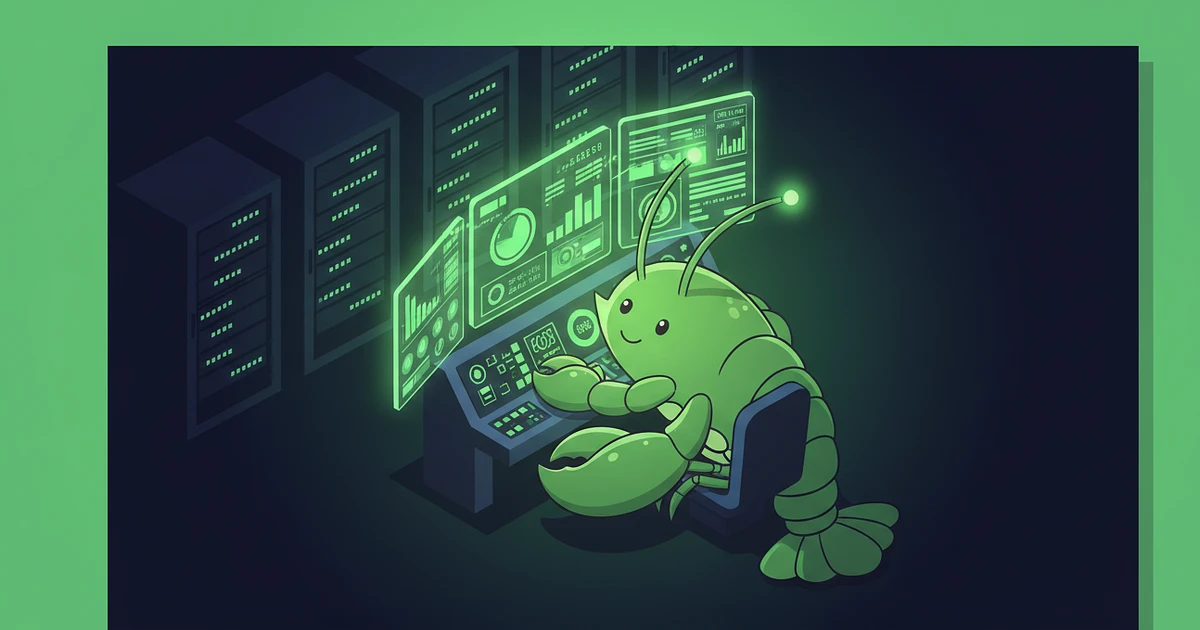
A team tweaked one system prompt. Looked fine in testing. In production, average reasoning chains jumped from 4 steps to 11. Token spend doubled. No error logs, no alerts, no HTTP 500s. They found out when the invoice arrived. That story, documented by Agentix Labs, is probably the best argument for ai agent observability you'll ever hear.
If you're running an AI agent in production, standard uptime monitoring won't save you. Your agent can be "up" and still burn through your budget, loop on the same tool call for 40 iterations, or quietly lose instructions as the context window fills up.
Here's what to watch instead.
Web apps are predictable. Same request, same response, same code path. AI agents aren't like that. The same input can trigger completely different chains of tool calls depending on what the model decides in that moment.
That creates problems traditional APM can't catch.
Silent failures. Your agent returns a confident-sounding wrong answer. No error code. No stack trace. Just a user who got bad information.
Cost spirals. A single agent turn can consume 30,000 input tokens when you add the system prompt, conversation history, tool schemas, and retrieved documents. Multiply that across dozens of turns per task.
Loop storms. The agent retries the same failing tool call over and over. Each retry costs tokens. No timeout, no circuit breaker, just a growing bill.
You need ai agent observability that tracks behavior, not just availability.
The industry has settled on a clear winner for llm observability in self-hosted setups. OpenTelemetry's GenAI semantic conventions define standard metric names that work across any AI framework. Contributors include Amazon, Google, IBM, and Microsoft.
The data flow looks like this:
| Component | Role |
|---|---|
| OpenTelemetry SDK | Instruments your agent, emits traces and metrics |
| OTel Collector | Receives OTLP data, exports to backends |
| Prometheus | Scrapes the collector, stores time-series metrics |
| Grafana | Visualizes everything, sends alerts |
All four run alongside your agent in Docker Compose. No SaaS vendor required. Your conversation data never leaves your server. Compared to paid ai observability tools like Datadog or Honeycomb, you trade a slick UI for full data ownership.
Not everything needs a dashboard. These are the six ai agent observability metrics that catch real problems, based on what we've seen across ClawHosters deployments.
| Metric | OTel Name | Why It Matters |
|---|---|---|
| Token usage | gen_ai.client.token.usage |
Cost control. Split by input vs output, by model |
| Operation duration | gen_ai.client.operation.duration |
End-to-end latency per LLM call |
| Time to first token | gen_ai.server.time_to_first_token |
User experience for streaming responses |
| Tool call success rate | Custom counter | Failing tools cause retry loops |
| Agent loop iterations | Custom counter | Catches runaway reasoning chains |
| Context window utilization | Custom gauge | Above 80%, reasoning quality drops off a cliff |
According to LangChain's 2024 State of AI Agents report, 89% of organizations running agents in production have already adopted observability tools. It's not a nice-to-have anymore. It's the baseline.
If you're running OpenClaw on a ClawHosters plan, good news. OpenClaw ships with a diagnostics-otel plugin that handles the instrumentation side for you.
Enable it with one command:
openclaw plugins enable diagnostics-otel
Configure your OTLP endpoint in the OpenClaw config, restart, and your instance starts exporting traces, metrics, and structured logs in standard OTel format. Token counts, cost attribution, execution duration, queue depth, session states. All of it.
From there, point a Prometheus scrape job at the OTel Collector's metrics endpoint and connect Grafana. The SigNoz OpenClaw monitoring guide walks through the full setup path if you want step-by-step instructions.
For an even simpler start, the community-built openclaw-metrics package adds a /metrics Prometheus endpoint directly to the gateway. It ships with a pre-built Grafana dashboard JSON covering around 30 metrics across seven categories.
Dashboards are great for exploration. But the real value of this stack is grafana alerting that wakes you up before costs spiral.
Set up these alerts:
Token budget threshold. Alert when daily token spend exceeds 120% of your 7-day average. Catches prompt regressions and loop storms early.
Context window warning. Alert when any session hits 80% of the model's context limit. Beyond that point, the model starts losing early instructions and quality degrades fast. Context compression can reduce token usage by 90%, but only if you know it's needed.
Tool failure rate spike. Alert when any tool's error rate crosses 15% over a 5-minute window. A broken tool is the most common trigger for retry loops.
Want to learn what else you can do to protect your instance? Check our security hardening guide and our breakdown of how to cut token costs by 77%.
A few things that trip people up.
Logging full prompts. Don't. Prompts contain user data. Log token counts and metadata, not content. Redact if you must trace full conversations.
Static latency thresholds. LLM response times vary by model, load, and prompt length. Use percentile-based thresholds (P95, P99) relative to your own baselines, not fixed numbers.
Missing model version labels. When you upgrade from GPT-4o to a newer release, your metrics need to reflect that. Label every metric with the model name and version so you can spot regressions.
Ignoring silent retries. Some agent frameworks retry failed LLM calls automatically without logging them. If your framework does this, instrument the retry path separately.
AI agent observability means tracking the internal behavior of your AI agent in production. Unlike traditional monitoring that checks uptime and HTTP errors, it focuses on token usage, reasoning chain length, tool call success rates, and context window utilization. The goal is catching problems that don't produce error codes, like cost spirals, silent failures, and degraded output quality.
No. The OpenTelemetry, Prometheus, and Grafana stack is fully open source. OpenClaw's built-in diagnostics-otel plugin handles instrumentation. You run the entire stack on your own server. No SaaS subscription, no data leaving your infrastructure.
Run `openclaw plugins enable diagnostics-otel`, set your OTLP endpoint in the config, and restart. OpenClaw will start exporting traces, metrics, and logs in standard OTel format. Point Prometheus at the OTel Collector and connect Grafana for visualization.
Track token usage (split by model and input/output), operation duration, time to first token, tool call success rate, agent loop iterations, and context window utilization. Token usage catches cost problems. Loop iterations catch runaway agents. Context window utilization catches quality degradation before users notice.
Traditional monitoring tracks availability, CPU, memory, and HTTP status codes. AI agents can be "healthy" by all those measures while producing wrong answers, looping on failing tools, or silently burning through tokens. You need behavioral metrics that track what the agent is doing, not just whether it's running.
*Last updated: March 2026*
Three open-source AI agent frameworks launched within two weeks of each other in early 2026. All three have the word "Claw" in the name. All three let you run your own AI assistant. And all three make completely different bets about what matters most.

Your OpenClaw agent reads, writes, searches the web, calls tools. But it can't hear you. And it can't talk back. Voice changes that, and it's not as complicated as you'd think.

Port forwarding your AI agent to the public internet is a terrible idea. OpenClaw has broad access to your system, shell, files, network, and it eagerly reaches out to external APIs. Exposing that to the open web is asking for trouble. Tailscale gives you encrypted remote access to your OpenClaw...