ClawHosters
by Daniel Samer
6 min read
Loading...
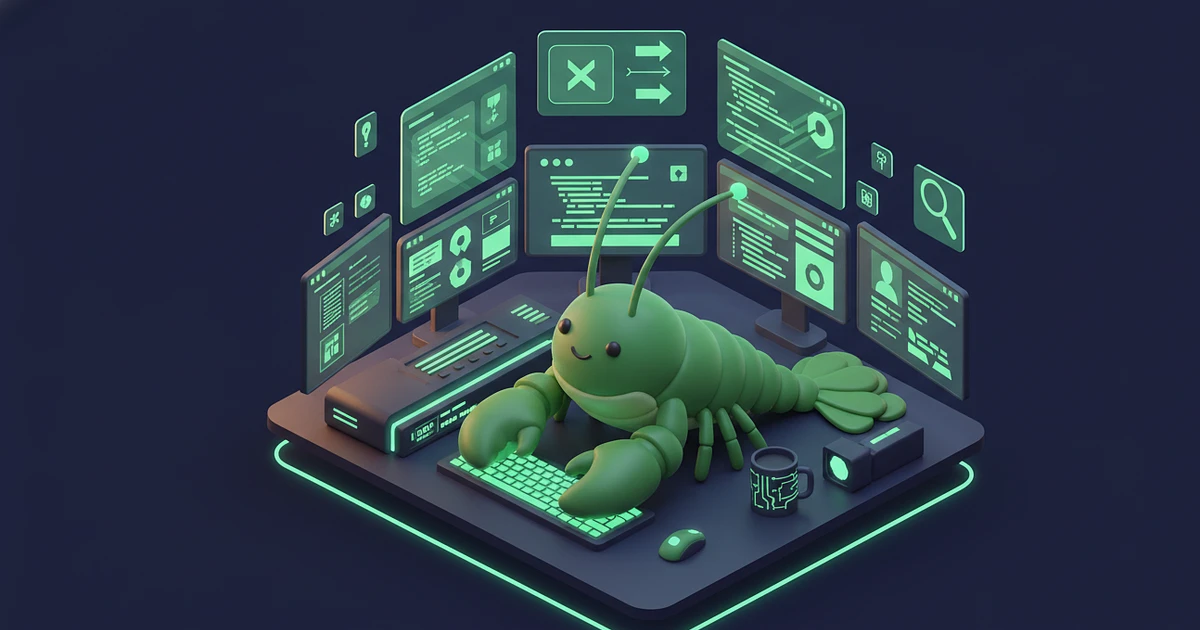
Most AI agents are smart but uninformed. They know the internet. They don't know your company's return policy, your internal API docs, or what your team decided in last Tuesday's meeting. That's the gap retrieval augmented generation fills.
OpenClaw ships with a built-in knowledge skill that turns your agent into a search engine for your own documents. Feed it files, and it answers questions by pulling the relevant chunks, citing where it found them. No external vector database required. No infrastructure to manage. This rag tutorial walks you through the setup.
RAG stands for retrieval augmented generation. In practice, it means your agent checks your documents before generating an answer.
Without RAG, you ask "What's our refund window?" and the agent guesses based on general training data. With the OpenClaw knowledge base enabled, it searches your uploaded docs, finds the paragraph about refunds, quotes it, and tells you the source file and page.
The difference is night and day. You go from "probably 30 days" to "14 days per Section 3.2 of your terms of service, uploaded on March 8." With a citation.
OpenClaw's knowledge skill uses workspace files. You drop documents into a folder, the agent indexes them, and they become searchable. Here's the config.
In your openclaw.json, enable the knowledge skill:
{
  "skills": {
    "knowledge": {
      "enabled": true,
      "workspacePath": "./knowledge",
      "chunkSize": 512,
      "chunkOverlap": 64,
      "citeSources": true
    }
  }
}
Then create the knowledge/ directory in your workspace and drop files in. Supported formats include .md, .txt, .pdf, .csv, and .json. The agent re-indexes on restart or when you run openclaw knowledge reindex.
That's it. No vector database to provision. No embeddings API key to configure (OpenClaw handles that internally). The indexing runs locally on your instance.
The knowledge base works best with structured, factual content. Think reference material, not stream-of-consciousness notes.
Good candidates:
Product documentation and API references
FAQ lists and support playbooks
Meeting notes with decisions and action items
Obsidian or Notion exports (export as Markdown)
HR policies, onboarding docs, compliance checklists
Sales enablement materials and pricing sheets
Bad candidates: raw chat logs, video transcripts without cleanup, massive database dumps.
One practical tip. Break large documents into topic-focused files rather than feeding in a single 200-page PDF. The chunking algorithm works better with smaller, well-structured inputs. A folder of 40 Markdown files beats one giant PDF every time.
When you ask your agent something, the knowledge skill runs a similarity search against your indexed documents. It pulls the most relevant chunks, includes them in the prompt context, and generates an answer with source citations.
You can test it immediately after indexing:
You: What's the SLA for critical bugs?
Agent: Per your support-tiers.md (lines 45-52), critical bugs
       have a 4-hour response SLA on the Enterprise plan and
       24-hour resolution target. Standard plan is 24-hour
       response, best-effort resolution.
The citeSources: true flag in your config is what makes the agent reference the exact file and location. Turn it off if you want cleaner answers without citations, but for internal knowledge bases, citations are what make people actually trust the output.
You could set this up on a VPS you manage yourself. But here's what you'd also be managing: disk space for the index, backups so you don't lose your knowledge base when a server dies, and updates when OpenClaw ships new retrieval improvements.
On ClawHosters, your workspace files persist across restarts and updates. Auto-backups cover your knowledge directory. When OpenClaw releases a new version with better chunking or retrieval, your instance gets updated automatically. You just manage the documents.
If you're weighing the options, the self-hosted vs managed comparison breaks it down in detail.
And if choosing the right AI model for your agent matters to you, the model you pick affects retrieval quality too. Larger context windows let the agent consider more chunks at once, which means better answers on complex queries.
Drop your first batch of documents in the knowledge/ folder and try it. Start with something small, maybe your product FAQ or a single runbook. Ask questions you know the answers to and see how the agent handles them.
If you don't have an OpenClaw instance yet, you can deploy your first agent on ClawHosters and have the knowledge skill running in under two minutes.
Retrieval augmented generation (RAG) is a technique where your OpenClaw agent searches your uploaded documents before generating an answer. Instead of relying only on its training data, it pulls relevant passages from your files and cites the source. This makes answers accurate and verifiable.
OpenClaw's knowledge skill supports Markdown (.md), plain text (.txt), PDF (.pdf), CSV (.csv), and JSON (.json) files. For best results, use well-structured Markdown files broken into topic-focused documents rather than one large file.
No. OpenClaw handles document indexing internally. You drop files into the workspace knowledge directory, and the skill indexes them without requiring an external vector database, embeddings API, or additional infrastructure.
There's no hard document limit. Practical limits depend on your instance's disk space and the model's context window. On ClawHosters, persistent storage and auto-backups handle the infrastructure side. For most use cases, hundreds of documents work fine.
Yes. Export your Notion pages or Obsidian vault as Markdown files and drop them into the knowledge directory. Markdown is the best-supported format for the knowledge skill. Clean up any broken internal links after export for best results.
*Last updated: March 2026*
Three open-source AI agent frameworks launched within two weeks of each other in early 2026. All three have the word "Claw" in the name. All three let you run your own AI assistant. And all three make completely different bets about what matters most.
Your OpenClaw agent reads, writes, searches the web, calls tools. But it can't hear you. And it can't talk back. Voice changes that, and it's not as complicated as you'd think.
Port forwarding your AI agent to the public internet is a terrible idea. OpenClaw has broad access to your system, shell, files, network, and it eagerly reaches out to external APIs. Exposing that to the open web is asking for trouble. Tailscale gives you encrypted remote access to your OpenClaw...