ClawHosters
by Daniel Samer
4 min read
Loading...
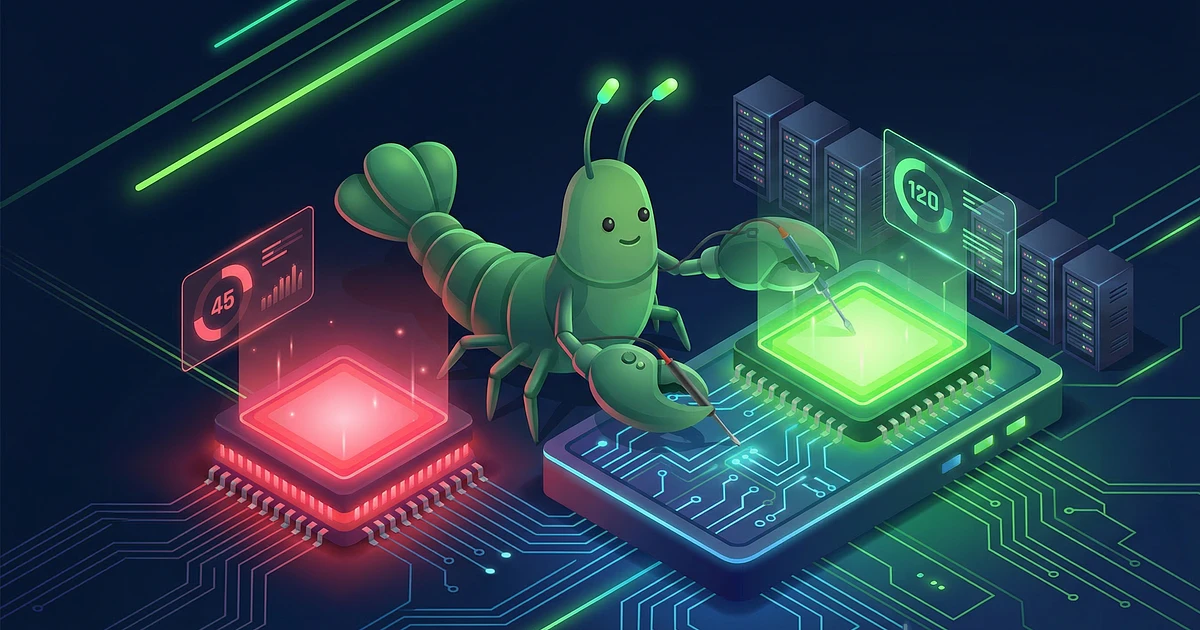
A chip manufacturer just created a consumer product category for AI agents. That hasn't happened before.
On March 13, AMD published an official guide for running OpenClaw locally on AMD hardware. Two branded configurations. Dedicated product pages. The whole playbook.
Here's what AMD is actually selling.
| Spec | RyzenClaw | RadeonClaw |
|---|---|---|
| Hardware | Ryzen AI Max+ (APU) | Radeon AI PRO R9700 (GPU) |
| Memory | 128GB unified | Dedicated VRAM |
| Speed (Qwen 3.5 35B) | ~45 tokens/sec | ~120 tokens/sec |
| Context window | 260K tokens | Standard |
| Concurrent agents | Up to 6 | Not specified |
| 10K input tokens | ~9.3 sec | ~4.4 sec |
| Use case | Agent swarms, long context | Raw speed |
The RyzenClaw configuration is probably the more interesting one. 128GB of unified memory means you can run larger models without a separate GPU, and AMD recommends allocating roughly 96GB to variable graphics. Six concurrent agents on a single chip is the kind of spec that makes agent swarm setups possible on a desktop.
RadeonClaw is the speed play. 120 tokens per second on Qwen 3.5 35B is fast. Really fast. Processing 10,000 input tokens in 4.4 seconds makes it viable for production-style workloads from a single GPU.
This is AMD's direct answer to NVIDIA's DGX Spark announcement. Both companies now have branded OpenClaw hardware configurations with dedicated marketing pages. AMD even calls them "Agent Computers", which is honestly a better brand name than anything NVIDIA came up with.
The race for local AI agent hardware is no longer theoretical. Two of the world's biggest chip companies are competing for it.
And there's a third option AMD announced alongside the hardware. The AMD Developer Cloud offers free vLLM-powered OpenClaw inference on AMD cloud infrastructure. No hardware purchase required. It's clearly a gateway drug to get developers building on AMD silicon before they commit to buying it.
Local hardware is exciting. But exciting comes with caveats.
A Ryzen AI Max+ processor costs somewhere north of $2,000. You still need to build or buy a machine around it. That machine draws power 24/7 if you want your agent always available. It sleeps when your PC sleeps. And if something breaks, you're the IT department.
That's exactly the gap managed hosting fills. Your OpenClaw instance runs on Hetzner servers in Germany, always on, with auto-updates and backups handled for you. No $2,000 processor purchase. No power bill surprise. If you're curious about the real cost breakdown, we did a detailed self-hosting vs managed comparison.
The AMD vs NVIDIA hardware race proves one thing clearly: local AI agents are going mainstream. How you run yours is a different question.
RyzenClaw is AMD's branded OpenClaw configuration for the Ryzen AI Max+ processor. It uses 128GB unified memory, delivers about 45 tokens per second on Qwen 3.5 35B, and supports up to six concurrent agents. AMD published the setup guide on March 13, 2026.
RadeonClaw (Radeon AI PRO R9700) runs at roughly 120 tokens per second on the same model, almost three times faster than RyzenClaw's 45 tokens per second. It processes 10,000 input tokens in about 4.4 seconds.
No. OpenClaw runs on any hardware that supports its requirements. AMD, NVIDIA, even CPU-only setups work. You can also skip hardware entirely with managed hosting like ClawHosters or the free AMD Developer Cloud.
Both offer branded configurations for running OpenClaw locally. NVIDIA has DGX Spark and RTX GPUs. AMD counters with RyzenClaw (APU) and RadeonClaw (GPU). The key difference: AMD also offers free cloud access for developers. NVIDIA does not.

On May 10, Hermes Agent by Nous Research passed OpenClaw in daily token usage on OpenRouter. Hermes hit 224 billion daily tokens against OpenClaw's 186 billion. By May 21 the gap had widened: 458 billion vs 173 billion.
A UK CEO's live OpenClaw instance showed up on BreachForums in February. Price tag: $25,000 in Monero. The listing advertised full access to the CEO's AI conversations, production database, Telegram bot tokens, and Trading 212 API keys. All stored in plaintext Markdown files.
On April 22, 2026, OpenAI announced Workspace Agents for ChatGPT Business and Enterprise customers. Think always-on, cloud-hosted AI agents that plug into Slack, Salesforce, Google Drive, and about a dozen other enterprise tools.